How is time represented in LLMs?
Can we measure the time horizon behind a language model's output?
So far, a direction in the activations of two Qwen3 models can be read and steered, shifting outputs between short- and long-term options. In one of them, horizons from seconds to centuries form an ordered map. These results come mainly from choice tasks, and open-ended output has only a rough, unvalidated score so far.
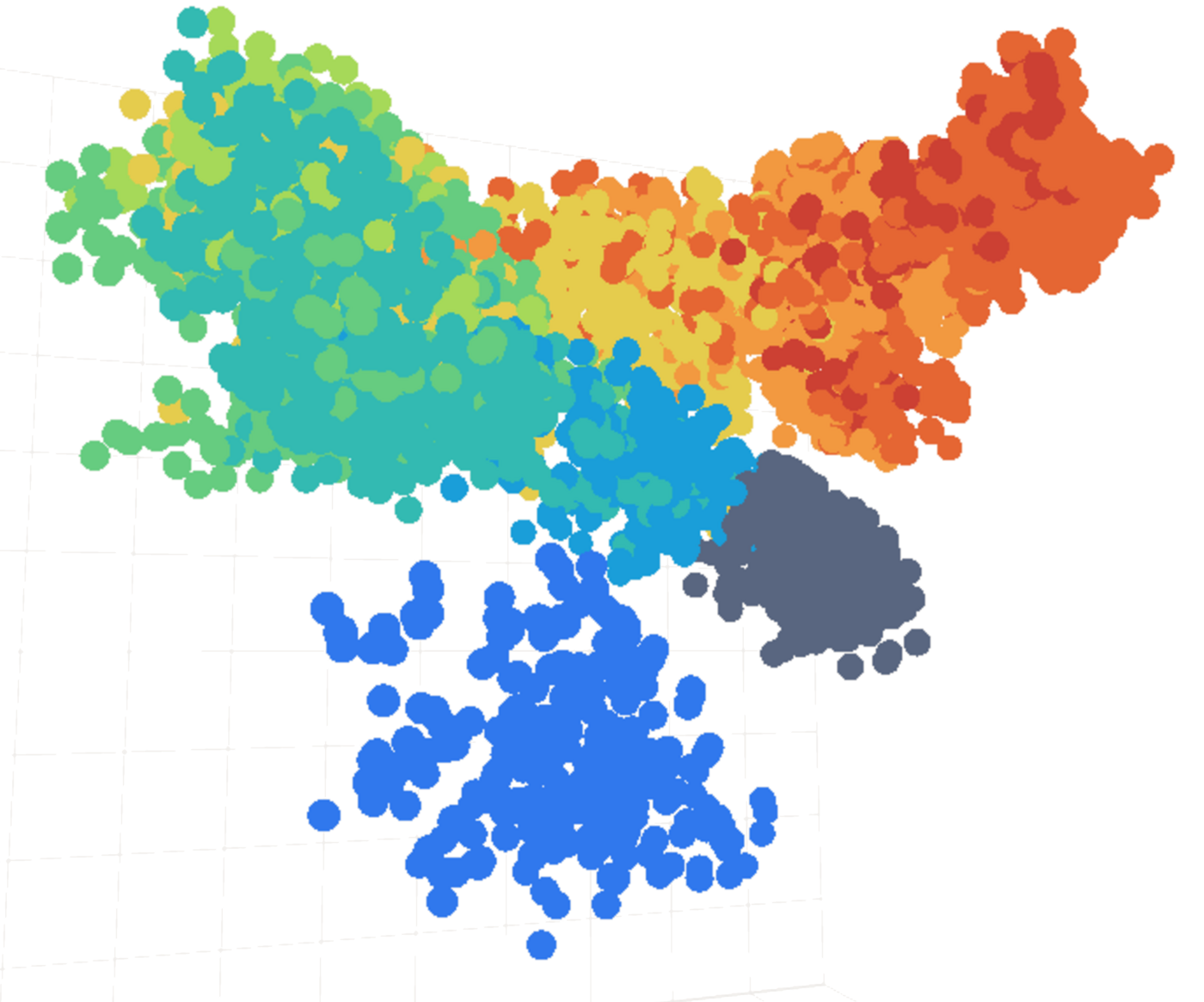
- Seconds
- Minutes
- Hours
- Days
- Weeks
- Months
- Years
- Decades
- Centuries
- No horizon
How does a time horizon become an output?
The current answer, step by step, with how much weight each step can carry.
Where is it computed?
In Qwen3-4B, a subgraph across layers 17–35. Attention at L24 is flagged by all four non-probing methods, and MLP effects concentrate at L31–35.
Methods largely agree, one model
What form does the horizon take?
Ordered clusters from seconds to centuries, on a curved manifold.
Qualitative PCA evidence, one model
When does it become a preference signal?
The horizon direction is unstable across prompt positions until the user-to-assistant boundary, where attention collapses it into a binary signal.
Qualitative PCA evidence, one model
Does a stated deadline reach the output?
Not reliably. When only the sooner option can pay out by the deadline, Qwen3-4B outputs select the undeliverable long-term option 47–53% of the time.
960 prompts, compared across 30 models
Does changing the signal change the output?
Yes, in the settings tested. At L44 of Qwen3-32B, long-term outputs move from 33.7% at steering strength −128 to 76.8% unsteered to 93.1% at +128. In Qwen3-4B, steering at L22 gives about 3.4× odds.
Controlled in Qwen3-32B, suggestive in Qwen3-4B
Is it really about time?
Not established. Chain reliability is decodable at about 95% in the same subgraph, and the Qwen3-32B direction may also carry abstraction, urgency and framing.
Open
How far does this generalize?
Unknown beyond two Qwen3 models. A direction transferred to a monetary task in Qwen3-32B, but both papers test one model family in thinking-disabled settings.
Open
Reading a signal and changing it are different tests
In both studies, the layers with the best probe accuracy differ from the layers with the largest steering effect. A probe used for oversight has to track what affects the output, so accuracy alone isn't enough.
Qwen3-4B 36 layers
Qwen3-32B 64 layers
What these results don't show
No surface baseline for the probes
Shuffled labels rule out chance, but no text-only baseline has been run on these datasets, and the same kind of baseline explained an apparent planning signal in generated code.
No prompting baseline for the steering
Asking for a short- or long-term answer might produce similar shifts. The strongest steering settings are also large perturbations.
One model family, narrow tasks
The two papers cover Qwen3 models with thinking disabled, mainly on choice tasks. Multi-turn and agentic settings are untested.
Not yet a monitor
No result here shows a probe flagging a change in advance. A related study of repetition looked for that lead time and found none.
Each gap is open work. See what you can pick up.
Papers
- Temporal Preference Concepts and their Functions in a Large Language Model
Ian Rios-Sialer, Shantanu Darveshi, Shuai Jiang, Avigya Paudel, Anastasiia Pronina, Ipshita Bandyopadhyay, Justin Shenk
BlackboxNLP 2026, extended abstract
- Intertemporal Preference Steering in Qwen3 via Contrastive Activation Addition
Michal Mráz, Justin Shenk
Mechanistic Interpretability Workshop at ICML 2026