How does a time horizon become an output?
This page follows the signal from the prompt to the output in two Qwen3 models, and marks where the evidence stops. Every number comes from the evidence ledger.
Three terms
- Time horizon: the future moment at which outcomes are evaluated.
- Temporal scope: the bounded interval of time over which outcomes are weighted. The time horizon is its upper bound.
- Temporal preference: how the value of an outcome changes with when it occurs. These studies measure it through outputs on choices between sooner and later rewards.
The definitions follow Rios-Sialer et al., Section 2. That paper and Mráz & Shenk are the main sources below.
Where is it computed?
In Qwen3-4B, four methods converge on a subgraph across layers 17–35: probing, two forms of attribution, and activation patching. Attention at L24 is flagged by all four non-probing methods. MLP effects concentrate at L31–35. Patching on 71 prompt pairs ranks four components above the rest: attention at L24 and L21, and MLPs at L35 and L31.
This is a subgraph-level result on a single financial task, not a traced circuit.
What form does the horizon take?
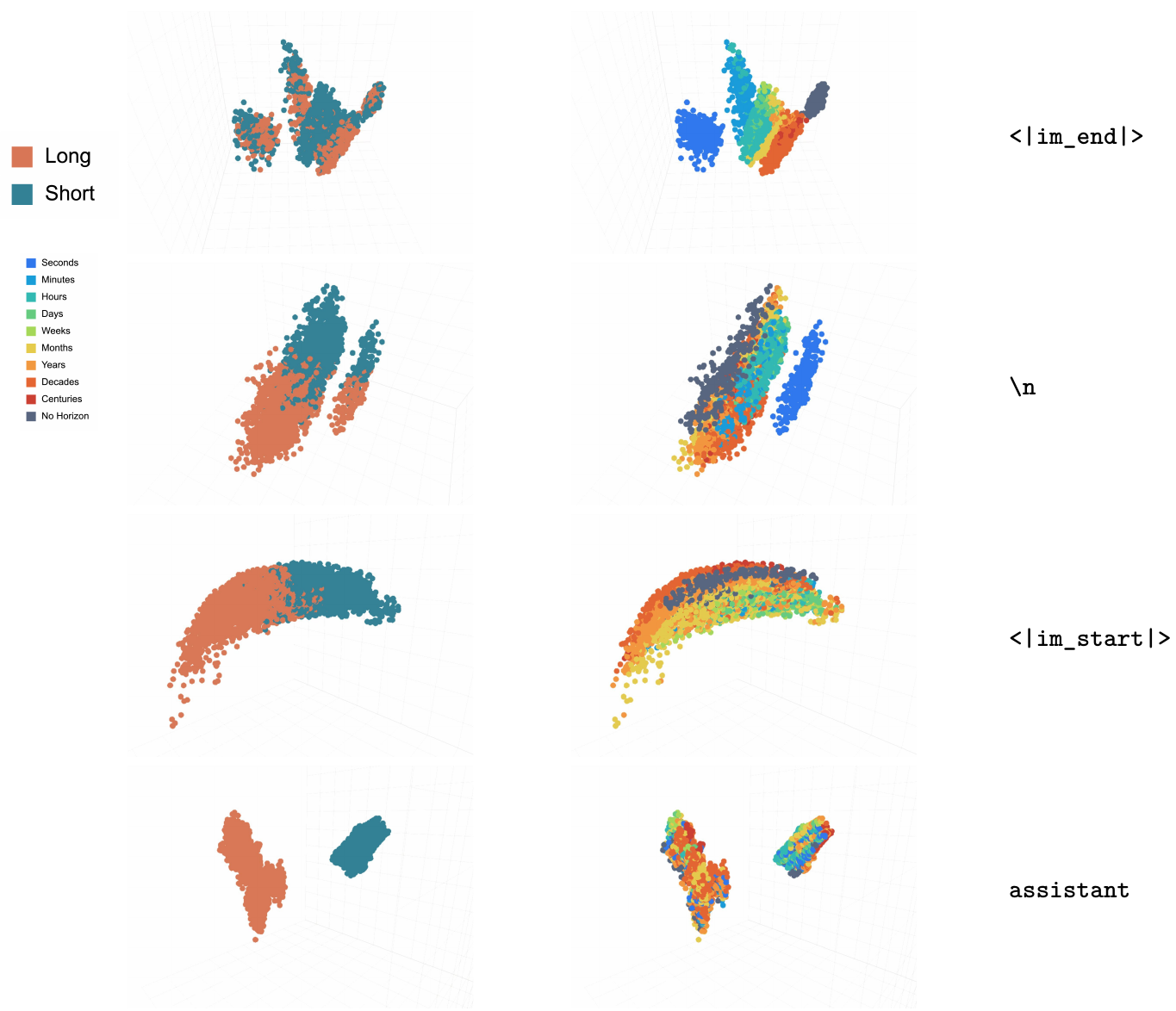
Horizons form ordered clusters from seconds to centuries, on what the paper describes as a curved manifold. Samples with no stated horizon sit apart at first.
This evidence is qualitative. It comes from PCA projections, and the main text reports no separation metric. A linear direction can still steer outputs across a curved structure, but the paper suggests that may be why output quality degrades at large steering strengths.
When does it become a preference signal?
The direction encoding the horizon is unstable across prompt positions until the user-to-assistant boundary. Over those four tokens, attention collapses the continuous representation into a binary signal. Long and short overlap heavily at <|im_end|> and separate cleanly by assistant, and the no-horizon samples align with the manifold.
Does a stated deadline reach the output?
Not reliably, and this is the main gap between representation and behavior. On 960 investment prompts, there is a zone of deadlines where only the sooner option can pay out in time. Qwen3-4B outputs select the undeliverable long-term option 47–53% of the time. Across the 30 models compared, only frontier API models reach 95–100%.
Fitted discount rates also sit 3–8× below human controls, and the paper reports that these preferences are unstable across contexts. A horizon can be clearly structured in activations without reliably shaping the output.
Does changing the signal change the output?
In the settings tested, yes. This is the strongest behavioral evidence so far.
At L44 of Qwen3-32B, long-term outputs on 100 held-out explicit prompts move from 33.7% at −128 to 76.8% unsteered to 93.1% at +128, a 59.4-point gap. A matched random direction moves them by at most 5.6 points, and sampled decoding preserves the pattern. On 300 implicit prompts the gap is 36.5 points.
In Qwen3-4B, steering at L22 with α = 50 gives about 3.4× odds, on 20 forced-choice prompts. The abstract calls this suggestive. Outputs also shift on 13 open-ended prompts, but those scores come from an LLM judge not validated against human ratings.
Three limits apply:
- Steering shows that adding a direction changes outputs, not that this direction drives them in normal operation.
- At L44, |α| = 128 is part of a range the authors call deliberately large, at 36–63% of the unsteered residual norm across layers.
- Neither paper reports a prompting baseline, so similar shifts might be possible by asking for them.
Moderate long-term steering also raises a planning-related capability metric on TravelPlanner, while +128 lowers it. The authors say this is not evidence that steering generally solves planning.
Where reading and changing differ
Qwen3-4B 36 layers
Qwen3-32B 64 layers
In Qwen3-4B, steering is strongest at L19–22 and weak at L26, where probe accuracy peaks. In Qwen3-32B, the largest choice gap is at L44, later in the network than the best probe layers. So the two can differ in either order, and a high probe score doesn’t identify the best place to intervene.
Is it really about time?
This isn’t established.
- Probe accuracy: a probe reaches 99.2% at L26 of Qwen3-4B on implicit pairs, and 77.0–83.5% in Qwen3-32B when trained on explicit questions and tested on implicit ones. Both have no surface baseline yet. Shuffled labels rule out chance, but the Qwen3-4B probe already scores about 80% at layer 0, before almost any computation.
- Shared subgraph: cumulative reliability of a reasoning chain is decodable at about 95% across L19–31 of the same model. It is linearly orthogonal to the temporal direction but sits on the same manifold, so the region encodes more than time.
- Correlated features: the Qwen3-32B authors note that their contrast also varies in abstraction, urgency, strategic scope and framing. The direction may be a broader short-term/long-term register.
- A precedent: in a related study of generated code, a classifier using only function and parameter names matched or beat probes that had appeared to detect planning. See related threads.
How far does this generalize?
The strongest transfer result is within Qwen3-32B: a direction trained on binary answers moves the indifference multiplier on a monetary task it was not trained on. At L40, the multiplier goes from 2.67 unsteered to 8.34 at −128 and 1.12 at +128.
Beyond that, little is known. Both papers use Qwen3 models with thinking disabled, and the Qwen3-4B work uses a single financial task. A project report finds that probe signal varies across Qwen, Llama and Phi, but cross-model causal work hasn’t been done. Multi-turn and agentic settings are untested.
That leaves the site’s main question open: these methods measure horizon-related signals in constrained tasks, and it isn’t yet known whether they can measure the horizon behind open-ended output.
Next: check the numbers, explore the geometry or pick up an open question.